The ruined pyramid at Hawara is only the beginning of the story.
Beside it stood the building Greek visitors called the labyrinth. Around it, later generations buried their dead. Beneath and around the monuments, researchers now investigate water as carefully as buried architecture. The result is a place that rewards more than a search for a hidden doorway: Hawara brings royal ambition, personal remembrance and the survival of an archaeological landscape into the same frame. UCL’s Hawara overview identifies the pyramid and temple of Amenemhat III alongside a cemetery used from the Middle Kingdom into Roman times; modern geophysical research adds the conservation challenge.
For a traveller, that changes the question. Instead of asking only what might be under the sand, ask what each layer can tell you—and how to recognise the difference between evidence and an evocative reconstruction.
One king, two pyramid sites
Amenemhat III did not begin his pyramid-building story at Hawara. His first pyramid was at Dahshur. According to UCL’s account of the king, problems with the ground led to a second site being chosen at Hawara towards the end of his reign. The king belonged to the Twelfth Dynasty, within Egypt’s Middle Kingdom. UCL: Amenemhat III.
That makes Hawara more than an alternative to the familiar Giza skyline. It offers a different way into pyramid history: the decisions behind a monument, the landscape chosen for it and the response when an earlier project ran into difficulty.
UCL also connects Amenemhat III with building projects elsewhere in the Fayum, including Medinet Maadi and Biahmu. Read in that regional setting, his pyramid belongs to a wider royal presence, rather than an isolated mystery on a blank patch of desert.
A labyrinth is not necessarily a garden maze
Forget the neatly clipped hedges and single winding path suggested by the modern word. Herodotus described a monumental arrangement of courts, colonnades and chambers. His account emphasises the bewildering experience of moving between spaces and the quality of the stonework. He was describing architecture that overwhelmed a visitor, not giving us a surviving, measured floor plan. Herodotus, Histories 2.148.
There is also a distinction inside his own narrative. He says he saw the upper rooms, while his account of the lower chambers came from their Egyptian custodians, who would not admit him. The famous total of 3,000 rooms belongs to that ancient account; it is not a modern excavation tally.
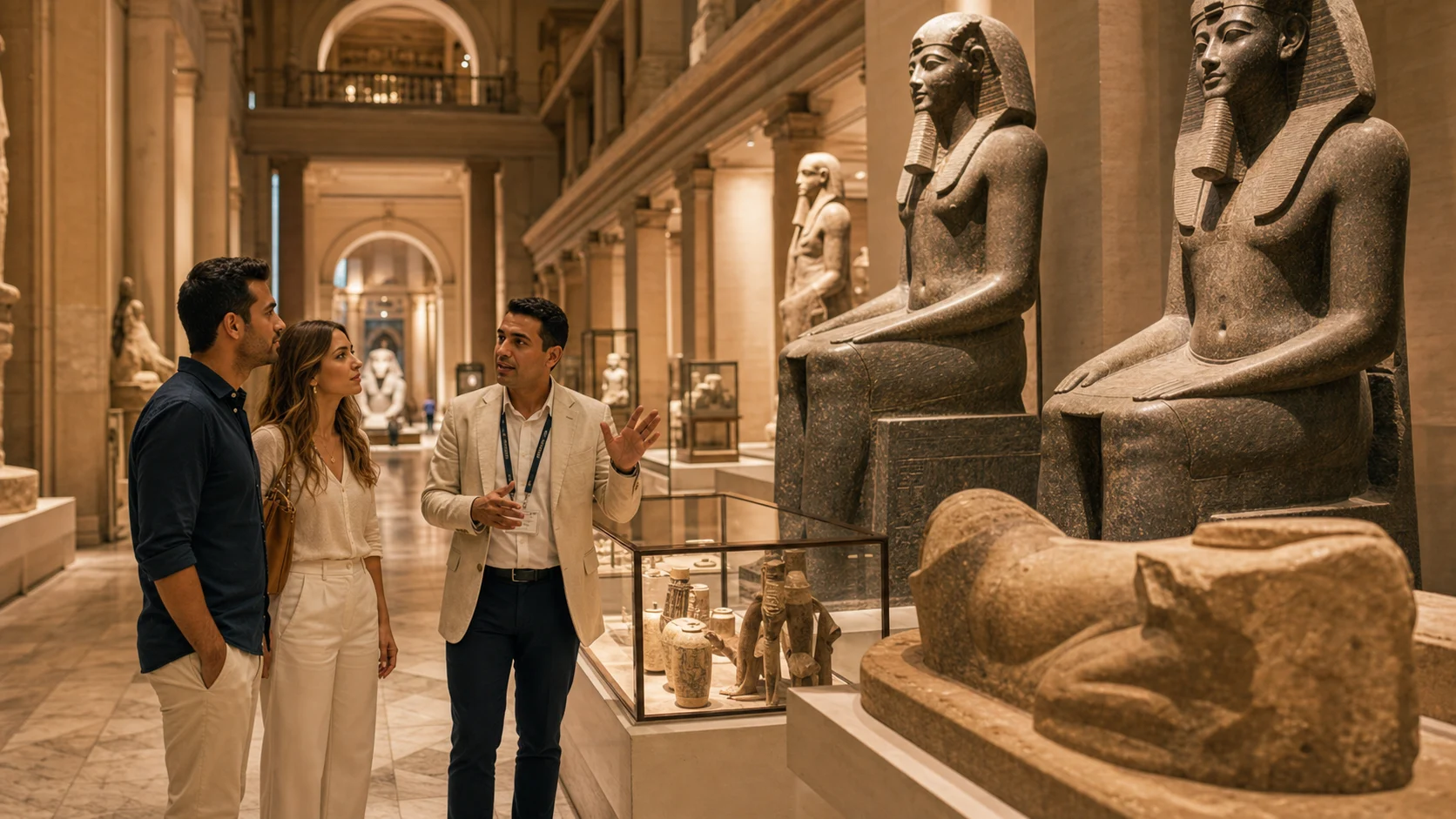
This is useful to remember on a guided visit. A compelling explanation should let you enjoy the ancient description without presenting every detail as something archaeologists have independently recovered. The distance between a visitor’s testimony and an excavated plan is part of Hawara’s fascination.
The people who came after the pharaoh
The labyrinth attracts the headlines, but Hawara’s later burials offer a more intimate encounter with the past.
Petrie’s nineteenth-century work at Hawara brought to light a major Roman-period cemetery containing mummies with painted portraits. These panels are striking because of their individual faces: people looking back at us, rather than another distant royal silhouette. The Metropolitan Museum of Art explains that portraits fastened into mummy wrappings brought Greco-Roman visual conventions together with Egyptian beliefs about the afterlife. The Met: Ancient Faces.
They belong to a much later chapter than Amenemhat III’s pyramid. Keeping those periods separate makes the site richer, not less mysterious. A royal funerary landscape could acquire new meanings long after its original king had died.
Before travelling, browse a museum collection online and read the provenance attached to a portrait. “Fayum portrait” is a broad label: the Met notes that such paintings were made beyond the Fayum too. Do not assume that every famous painted face came from Hawara, or that those objects are displayed at the site today.
Why the water matters as much as the walls
The quieter Hawara story is also an urgent one: understanding the water moving through the site.
A study published in the Delta Journal of Science in 2024 combined electrical resistivity tomography with transient electromagnetic surveying. The researchers investigated possible buried remains and the groundwater conditions affecting the pyramid and its surroundings. Their findings describe potential archaeological anomalies that require excavation to verify, alongside evidence of water intrusion. The paper discusses surrounding cultivation and possible leakage from damaged water infrastructure—not simply an abstract obstacle called “flooding.” Elshazly and colleagues, 2024.
This gives the conservation story a practical dimension. Investigating what survives and protecting it are connected jobs. A promising survey response does not identify a room’s contents, and the decision to dig involves more than choosing the most exciting patch on an image.
For visitors following the research, the valuable update may be an improved understanding of water movement or a carefully recorded architectural fragment. Progress does not have to resemble a spectacular chamber opening to matter.
What the 2026 reports actually add
There is a real fieldwork story to follow, with attribution kept clear.
On 7 May 2026, the Egyptian newspaper Veto quoted Ashraf Sobhi, Director General of Fayoum Antiquities, saying a Supreme Council of Antiquities and Fayoum antiquities mission was continuing excavations at the labyrinth location to seek its remains. That is a report of ongoing work—not, by itself, an announcement that the whole ancient complex has been recovered. Veto’s dated report.
Separately, the Archaeological Rescue Foundation’s July update presents site footage and photographs it describes as showing a large stone wall exposed during excavation. This is a project advocate’s account and should be read as such, rather than substituted for an excavation report establishing the wall’s date and relationship to the wider complex. ARF: Hawara updates.
Neither source establishes a fully accessible underground labyrinth for tourists. Claims about a large metallic object arise in the scan-interpretation material promoted by ARF; they are not an excavated object documented by these sources. For travel planning, there is no basis here to promise a visit to that supposed object or to the lower rooms described by Herodotus.
Beautiful reconstructions are not photographs of the past
Hawara also offers a lesson in how we picture lost places. A polished reconstruction can make an uncertain layout feel settled simply because it looks convincing.
Farida Mekheimar’s doctoral research at Nottingham Trent University tackles that problem directly. Her Hawara virtual-reality project presents different historical reconstructions to help non-specialists understand uncertainty rather than hide it. Mekheimar, 2023: thesis abstract.
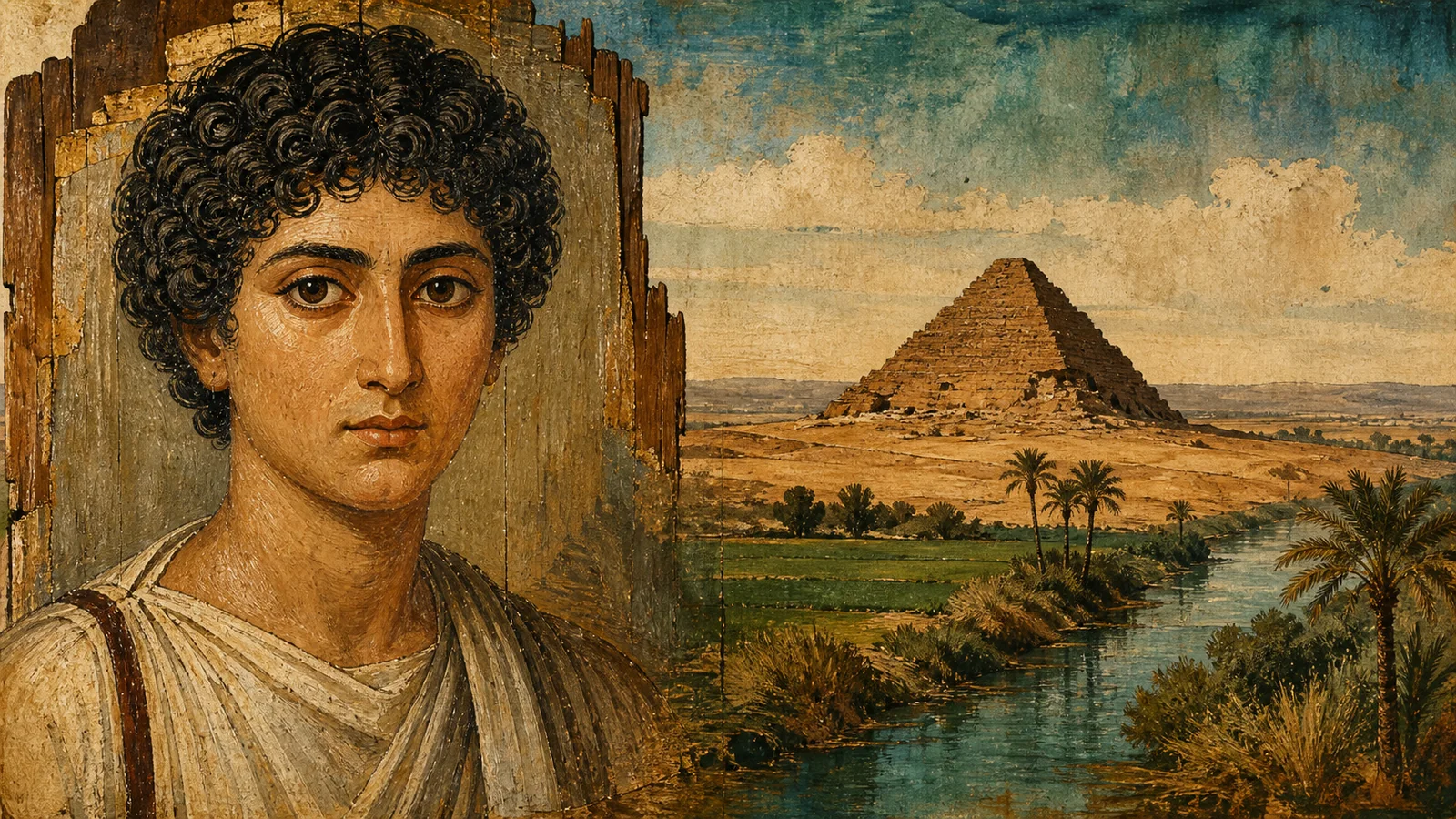
Bring that question to every striking labyrinth image: is it a photograph, a survey plot, a reconstruction based on particular assumptions, or an artist’s illustration? Each can be useful, but they do different jobs. The artwork accompanying this article is an AI-generated editorial collage, including an imagined portrait. It is not an archaeological find, a site map or a record of an excavation.
Put Hawara in a Fayum day, not a rushed Luxor detour
Hawara belongs to the Fayum region, southwest of Cairo. Plan it with the Cairo/Fayum portion of an Egypt journey, separately from your Luxor sightseeing. Egypt’s official tourism material lists Hawara and the pyramid at Al-Lahun among the region’s ancient monuments. Experience Egypt: Nile Valley guide.
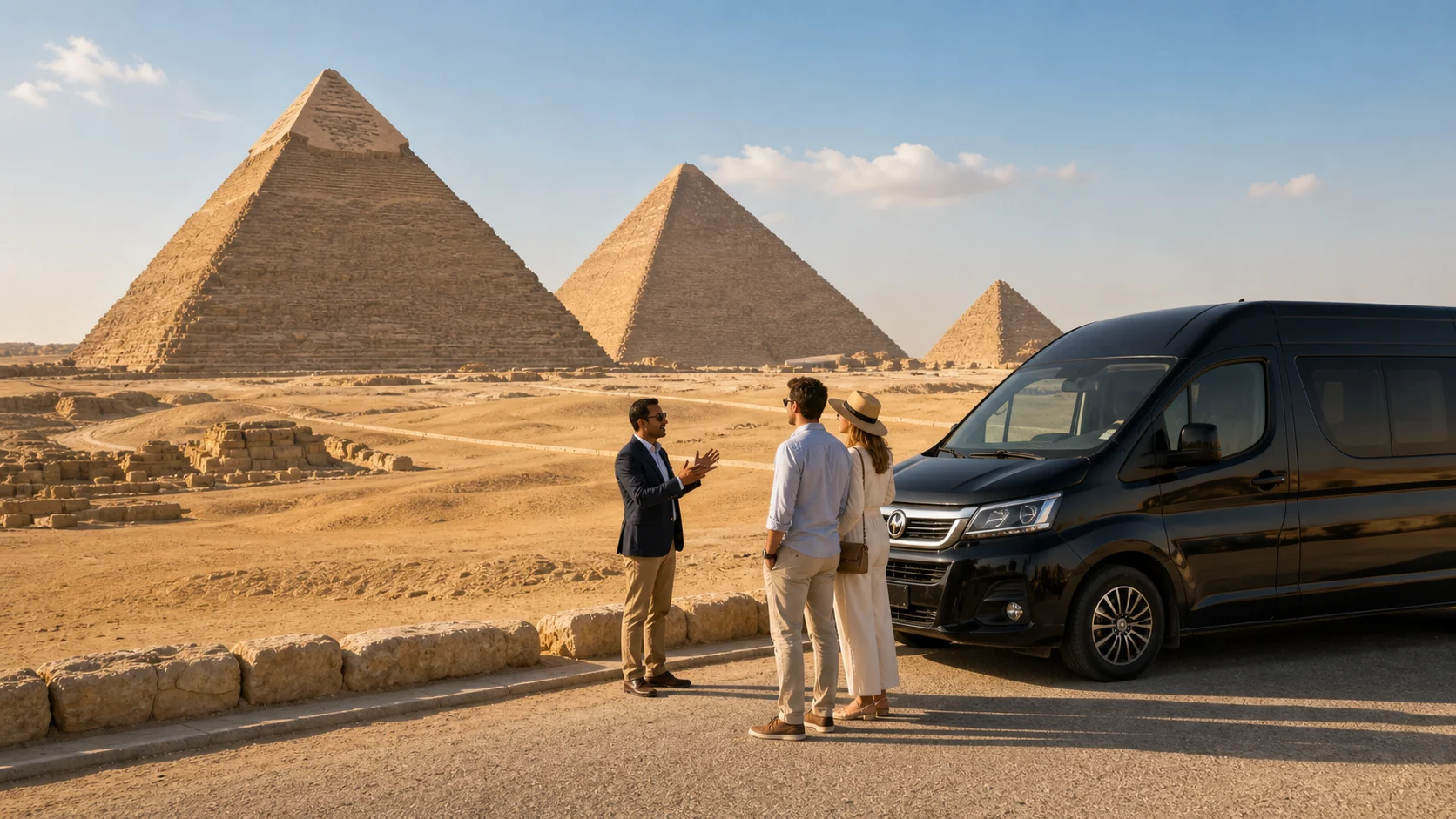
One sensible outline is a pyramid-focused day built around Hawara, with Al-Lahun considered as a second stop if current access and driving arrangements allow. This is a suggested framework, not a fixed excursion or a promise that both interiors will be open.
Before committing, ask the operator or guide to confirm:
- Which areas are open on your date, and whether the visit is exterior-only.
- The actual pickup point, driving plan and return arrangements.
- Whether admission, guiding and any necessary permissions are included in the quote.
- Whether the group’s walking needs can be accommodated.
- What the alternative plan is if access changes.
Leave the day enough breathing room for explanation, photographs and a meal. A site whose significance depends on understanding what is missing benefits from an unhurried guide more than from another hurried stop.
Questions worth taking to Hawara
Is Hawara the same place as the pyramids of Giza?
No. Hawara is a separate archaeological site in the Fayum region. Treat it as its own journey, not another monument within the Giza plateau.
Does the 3,000-room description prove those rooms survive?
No. It records what Herodotus reported. Establishing the surviving layout requires archaeological evidence, and his account distinguishes personal observation from information supplied by others.
Should I expect to enter the labyrinth?
Do not book on that assumption. Ask for precise, current access information. Excavation activity and permission for tourist entry are different things.
What makes Hawara worthwhile beyond the mystery?
Its combination of a Middle Kingdom royal monument, a later burial landscape and an active conservation problem. Seeing those chapters together gives the site a story that does not depend on any one sensational claim.
The most rewarding approach is to arrive curious, not with an answer already chosen. Hawara can hold an ancient writer’s astonishment, the humanity of a painted face and the precision of a modern survey at once. None needs to erase the others.
Continue planning your Egypt journey
Explore our Egypt Travel Guide and private Egypt tours. If Hawara interests you, send us your dates, starting point and archaeological interests. We can discuss whether a Fayum visit fits your wider route; access and any arrangements must be confirmed before booking.
Sources checked 31 August 2026. Ancient accounts, research interpretations and reported excavation activity are identified separately. Visitor access must be checked again for the travel date.
Make room for discovery
Build a route around the places that interest you. Confirm access and arrangements before booking.
Discuss your itinerary