2027 Total Solar Eclipse in Luxor: Date, Local Times, Duration and Travel Guide
The essential planning guide to Luxor’s August 2, 2027 total eclipse—from local contact times to heat, eye safety and accommodation.
Published 2026-08-07 · Updated 2026-08-07
The essential Luxor eclipse facts
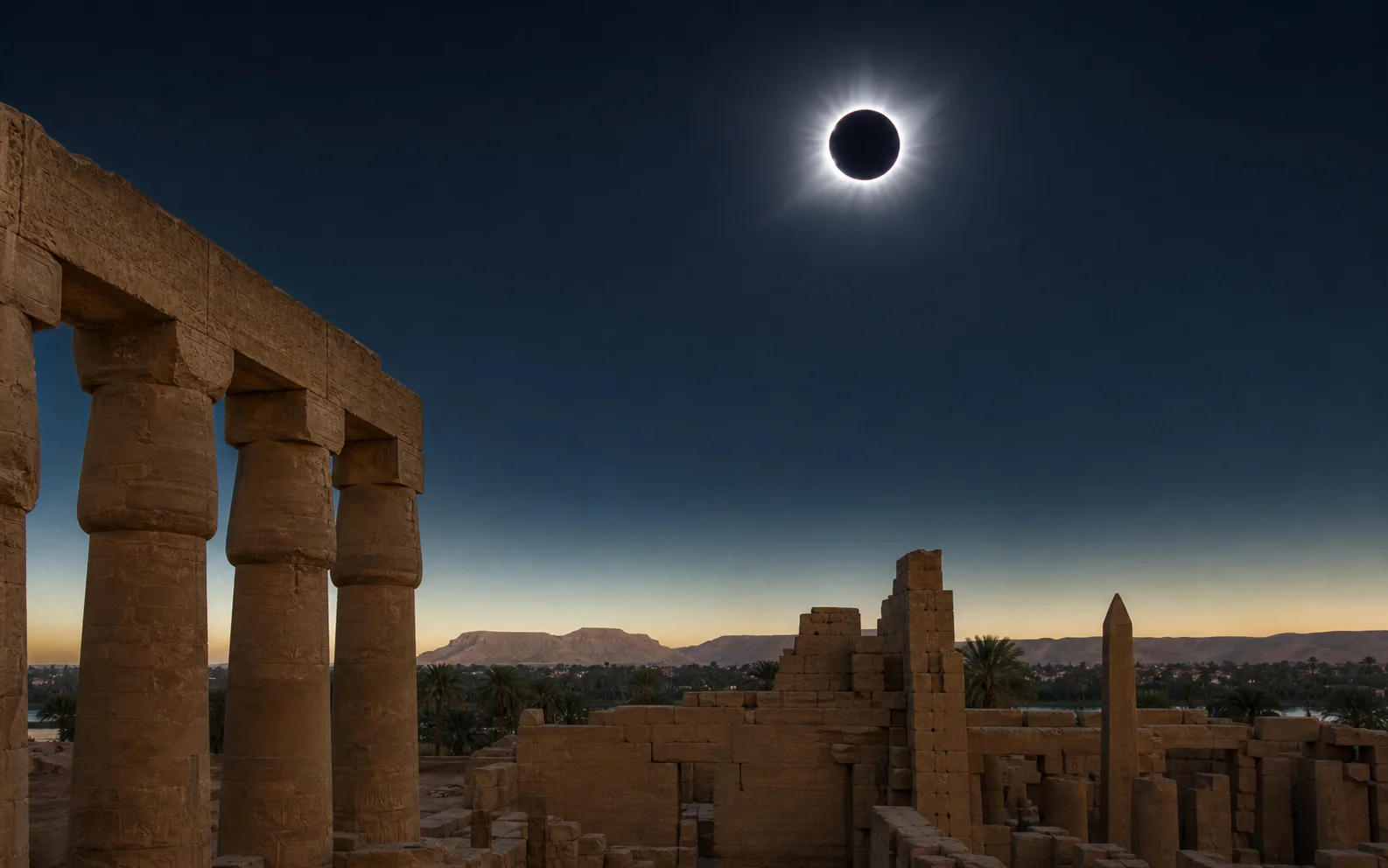
Luxor will experience a total solar eclipse on Monday, August 2, 2027. Current calculations for the city place the beginning of the partial phase at about 11:40 local time, maximum eclipse around 13:05 and the end near 14:26. Totality lasts approximately 6 minutes 22 seconds at Luxor, although the precise duration and contact times vary by exact viewing coordinates. Recheck an authoritative eclipse calculator for your final location closer to the date rather than relying on a screenshot saved years earlier.
Why Luxor is attracting eclipse travellers
The city lies close to the zone of exceptionally long totality and combines the astronomical event with Karnak, Luxor Temple and the Theban necropolis. Historical cloud statistics for early August are encouraging, but clear-sky climatology is not a guarantee: dust, haze and local conditions still matter. Demand is already intense, with specialist eclipse tours and several accommodation packages sold out or waitlisted. Travellers who want flexibility should secure legitimate accommodation and transport before buying a complicated sightseeing programme.
Choosing a viewing location
Being inside the path of totality is only the first requirement. A good site also needs legal access, an unobstructed view of the sun, controlled capacity, toilets, drinking water, shade, emergency access and a credible transport plan. Do not assume that a temple, hotel garden, rooftop or agricultural field will admit independent visitors on eclipse day. Only advertise or purchase a named venue when written access and operating arrangements are confirmed. Keep a backup location and allow organisers to adjust for local conditions.
Eye safety is non-negotiable
Use genuine eclipse viewers that comply with the ISO 12312-2 international safety standard and obtain them from a reputable supplier. Ordinary sunglasses are not safe. During the partial phases, keep certified protection over your eyes whenever looking toward the sun. Only during the brief total phase—when the sun’s bright face is completely covered—can viewers be removed, and they must go back on immediately as totality ends. Cameras, binoculars and telescopes require correctly fitted solar filters on the front of the optics.
August heat changes the event plan
Maximum eclipse occurs around early afternoon, when Luxor in August can be extremely hot. The viewing operation should be designed around heat before it is designed around spectacle. Arrive with sufficient water, electrolytes, shade, hats, lightweight covering and a plan for guests with medical conditions. Air-conditioned refuge or a nearby building is valuable, but everyone must still reach the viewing area in good time. Avoid packing major temple visits into the hottest hours before or after the eclipse.
Accommodation and transport
Do not plan to arrive from Cairo on eclipse morning. Flights, roads, station transfers and security arrangements may all be under pressure. Stay in or near Luxor for several nights and use transport controlled by your accommodation or event organiser. East Bank and West Bank both lie in the eclipse zone, but the river affects vehicle routing and crowd movement. Royal Nile Villas offers a West Bank apartment base, while Egyptian Tours can coordinate airport collection and private local transport once the viewing plan is confirmed.
A sensible five-day rhythm
Arrive by July 30 or 31, use the first full day for orientation and only light sightseeing, visit the main temples early on a separate morning, reserve August 2 for the eclipse alone, and keep August 3 flexible for rest or a private West Bank tour. A longer stay is safer than a compressed fly-in because it protects the central experience from ordinary travel disruption. If you add Cairo, Aswan or a Nile cruise, place those before or after the Luxor eclipse block rather than moving accommodation on August 1 or 2.
What is confirmed—and what is not
The astronomical date, path and calculated Luxor timings are predictable. Hotel inventory, venue permissions, traffic management, temple access, special-event rules and flight schedules can change. We will update this guide when official local arrangements are published. Any package should state clearly whether it includes only accommodation and transfers or also guarantees access to a specific managed viewing site.
Local tips
- Stay in Luxor for several nights; do not fly in on eclipse morning.
- Use ISO 12312-2 compliant eclipse viewers from a reputable source.
- Demand written confirmation of any named viewing venue.
- Prioritise shade, water and medical access.
- Keep August 2 free of ambitious sightseeing.
- Recheck exact local contact times for the final coordinates.
Sources and further reading
- Luxor local eclipse times
- American Astronomical Society eye-safety guidance
- Sky & Telescope Luxor 2027 travel programme
Join the Luxor Eclipse 2027 priority list
Tell us your dates, party size and preferred level of accommodation. We will only describe viewing access as confirmed once the venue and transport arrangements are secured in writing.
Enquire about Eclipse 2027